
What if the very walls meant to protect your family are actually trapping pollutants that make your respiratory symptoms worse? Many homeowners find that keeping windows closed doesn't stop the dust or that nagging stuffy feeling in certain rooms. In fact, research from the EPA shows that indoor air is often two to five times more polluted than the air outside. Managing the indoor air quality Orange County families breathe every day is about more than just comfort; it's about understanding the closed-loop system of your home's ventilation and how it affects your long-term health.
It's frustrating to feel like your sanctuary isn't as clean as it looks, especially when you're constantly dusting furniture or dealing with persistent allergies. We're here to help you move past the guesswork with a clear, honest look at what's actually circulating in your living spaces. You'll discover practical steps to reduce allergens and learn why the latest 2026 building codes now require higher-efficiency MERV 13 filters for better protection. This guide explores how professional strategies like whole house fans and updated ductwork can create a lasting, healthy environment for your family.
Key Takeaways
- Understand why the indoor air quality Orange County homes experience is often two to five times more polluted than the air outside.
- Identify the common external and internal pollutants, from wildfire smoke to household cooking fumes, that impact your family's health.
- Learn why standard one-inch filters often fall short and how upgrading to MERV 13 filtration provides a more effective barrier against fine particles.
- Discover how professional solutions like whole house fans and ductwork repairs create a consistent flow of fresh air throughout your living spaces.
- Gain the confidence to choose long-term ventilation strategies that address the specific layout and needs of your Southern California home.
What is Indoor Air Quality (IAQ) and Why Does it Matter in Orange County?
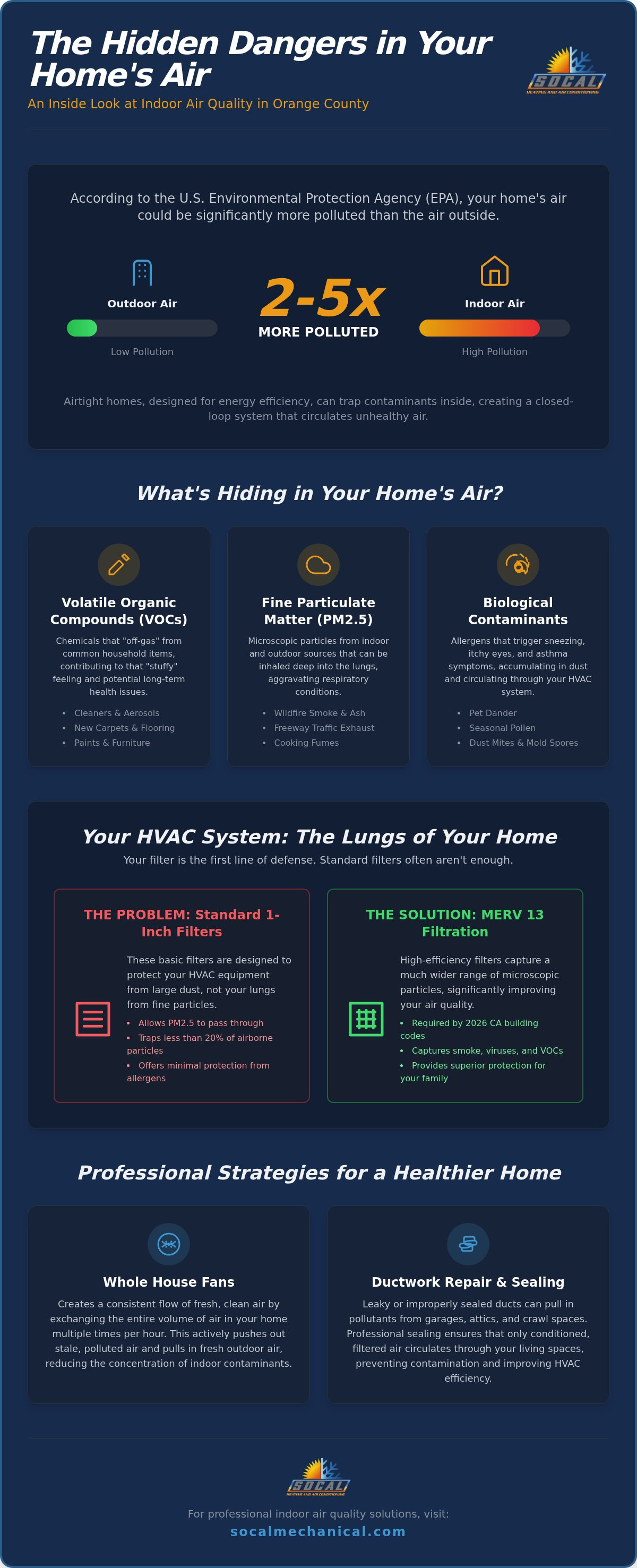
What is Indoor Air Quality (IAQ) refers to the air quality within and around buildings, specifically as it relates to the health and comfort of the people living inside. It's a common misconception that staying indoors protects you from pollution. The U.S. Environmental Protection Agency (EPA) has found that indoor air can be two to five times more polluted than outdoor air. For many residents, managing indoor air quality Orange County is a vital part of maintaining a healthy home, especially as modern building techniques prioritize airtight seals that can inadvertently trap contaminants.
Orange County's unique geography creates a specific set of challenges for local homeowners. During Santa Ana wind events, dry air carries fine dust and wildfire particulates across the region and into our living spaces. Conversely, our coastal humidity can trap moisture inside, leading to stagnant conditions in rooms that lack proper airflow. As of 2026, California's updated Title 24 building standards emphasize energy efficiency, which often means homes are sealed tighter than ever. While this helps with utility bills, it also means that without professional indoor air quality Orange County solutions, pollutants remain trapped in a closed loop.
The Health Impact of Poor IAQ
Poor air quality doesn't always announce itself with a distinct smell. It often shows up as persistent sneezing, itchy eyes, or a heavy, "stuffy" feeling in specific rooms. For families in Tustin and Irvine, these symptoms can be more than just a minor nuisance. Children and seniors are particularly sensitive to these environmental changes. Long-term exposure can aggravate asthma or lead to chronic respiratory issues; this makes it essential to address the root cause of the irritation rather than just treating the symptoms with over-the-counter medicine.
Common Pollutants Found in Southern California Homes
Understanding what is in your air is the first step toward clearing it. Most homes deal with a combination of three main pollutant types:
- Volatile Organic Compounds (VOCs): These are chemicals that "off-gas" from common household items like cleaners, new carpets, and even certain types of furniture.
- Fine Particulate Matter (PM2.5): These tiny particles often come from nearby freeway traffic, cooking fumes, or wildfire smoke. They are small enough to be inhaled deep into the lungs.
- Biological Contaminants: This category includes pet dander, seasonal pollen, and dust mites that naturally accumulate over time.
By identifying these sources, you can begin to implement a methodical approach to cleaning your home's air and ensuring a safer environment for your family.
Identifying the Sources of Air Pollution in Your Home
Understanding the Sources of indoor air pollution is the first step toward creating a healthier living environment. While we often think of our homes as sealed sanctuaries, they are actually dynamic environments where outdoor and indoor elements constantly interact. In Southern California, our proximity to major transit corridors and the Pacific Ocean introduces specific challenges. For example, homes near the I-5 or the 405 often face higher levels of freeway exhaust, while coastal properties must contend with persistent humidity that can encourage hidden mold growth behind drywall or under cabinetry.
Internal factors are just as significant. Everyday activities like searing a steak or using a gas range without a high-powered vent hood release fine particles into the air. Even the furniture you bought recently might be off-gassing chemicals from adhesives and flame retardants. One often overlooked danger is the attached garage. If your ductwork has leaks or the seals on your entry door are worn, carbon monoxide and gasoline vapors from your vehicle can easily migrate into your primary living areas. If you're concerned about these invisible threats, scheduling a professional indoor air quality assessment can help pinpoint exactly where your home's defenses are failing.
Wildfire Smoke and Seasonal Winds
Orange County residents are all too familiar with the hazy skies that accompany wildfire season. As we look toward the peak seasons of 2026, it's important to realize that standard window seals aren't enough to keep out microscopic ash and fine particulate matter. During Santa Ana wind events, high-pressure systems push these pollutants through even the smallest gaps in your home's exterior. These fine particles bypass the body's natural defenses and settle deep in the lungs, making it essential to have a filtration system that can handle the increased load during these high-risk periods.
Household Habits That Degrade Air Quality
Sometimes, the things we do to make our homes feel "cozy" actually degrade the indoor air quality Orange County families depend on. Scented candles and plug-in air fresheners may smell pleasant, but they often release VOCs and soot into the air. Modern homes are designed to be extremely airtight for energy efficiency. While this is great for your electric bill, it creates a "thermos effect" where toxins from cleaning supplies, pet dander, and cooking fumes have nowhere to go. Without active ventilation, these pollutants simply recirculate through your HVAC system, becoming more concentrated over time.
How Your HVAC System Acts as Your Home’s Lungs
Your central HVAC system is more than just a temperature regulator; it functions as the primary lungs of your home. While standalone air purifiers can help in a single room, your central system is responsible for circulating and filtering all the air throughout your entire living space. If this system is neglected, it doesn't just fail to clean the air; it can actively contribute to a range of health issues by redistributing dust, mold spores, and allergens. Maintaining high indoor air quality Orange County depends on ensuring that these "lungs" are breathing clearly and efficiently.
Many homeowners rely on standard one-inch pleated filters, but these are often insufficient for modern needs. As of January 1, 2026, California building codes mandate MERV 13 filters for new ducted systems to better capture fine particles. However, simply sliding a thicker filter into an older unit can lead to "blind filtration." This happens when the filter is too restrictive for the blower motor, which causes the system to work harder, consume more energy, and eventually suffer mechanical failure. A professional assessment ensures your filtration is effective without compromising the health of your equipment.
The Critical Role of Ductwork
Even the best filter in the world can't protect you if your ductwork is compromised. In many Orange County homes, ducts run through unconditioned spaces like attics or crawlspaces. If these ducts have gaps or tears, the vacuum effect pulls in dusty, unfiltered air from these dirty areas and pumps it directly into your bedrooms. It's helpful to learn the signs of leaky air ducts home owners should watch for, such as uneven cooling or excessive dust buildup near vents. Addressing these issues through professional ductwork repair Orange County is one of the most effective ways to seal out contaminants for good.
Advanced Filtration: MERV Ratings Explained
MERV, or Minimum Efficiency Reporting Value, is a scale from 1 to 16 that measures a filter’s ability to capture particles. While a low MERV filter only catches large dust bunnies, a MERV 13 or higher can trap microscopic particles like wildfire smoke and viruses. HEPA filtration is even more advanced, but it often requires specialized equipment because most residential blowers can't push air through such dense material. Before you upgrade your indoor air quality Orange County strategy with a high-efficiency filter, you should consult a professional to verify that your system’s static pressure can handle the change without damaging the blower motor.
Practical Strategies for Improving Home Air Quality
Improving your living environment requires a methodical approach that goes beyond simply changing a filter. The most effective starting point is source control. This involves identifying and removing the cause of pollution whenever possible, such as choosing low-VOC paints or ensuring that your kitchen vent hood is actually vented to the outside. When you stop pollutants at the source, you significantly reduce the workload on your filtration system. Additionally, maintaining proper humidity is vital for a healthy home. Keeping your indoor humidity levels between 30% and 50% prevents the growth of mold and keeps dust mite populations under control, which is especially important in our coastal climate.
Once sources are managed, the next step is active air cleaning. Utilizing high-efficiency filters and dedicated air scrubbers ensures that the particles you can't see are effectively removed from circulation. These strategies work together to create a multi-layered defense system for your indoor air quality Orange County environment, ensuring that every breath your family takes is as clean as possible.
Whole House Fans: The Orange County Secret
In communities like Tustin and Anaheim, whole house fans have become a favorite solution for natural ventilation. These systems work by pulling cool, fresh outdoor air into your home through open windows and exhausting stale, warm air out through the attic vents. This rapid exchange flushes out indoor toxins and odors in a matter of minutes. Beyond the immediate refreshing feel, these fans offer significant energy-saving benefits by reducing the need for traditional AC during the evening. It's a highly effective strategy for reducing allergens in your Orange County home because it prevents pollutants from becoming trapped and concentrated in your living spaces.
Air Scrubbers and UV Lights
For homeowners looking for the highest level of protection, integrating advanced technology into the HVAC system is a smart move. UV-C light systems are installed directly inside your air handler to kill bacteria and mold spores before they can enter your ductwork. While a standard filter is a passive barrier, an air scrubber is an active solution. These devices use specialized light and catalytic processes to neutralize odors and microscopic contaminants throughout the entire home. If you want to see which of these technologies is right for your specific home layout, you can book a professional air quality assessment to get a customized recommendation for your indoor air quality Orange County needs.
Professional IAQ Solutions with SOCAL Heating and Air Conditioning
Achieving superior indoor air quality Orange County requires more than just buying a portable air purifier. It requires a comprehensive understanding of how your home breathes. At SOCAL Heating and Air Conditioning, we provide detailed air quality assessments that look beyond the surface. We examine your ductwork for leaks, check your system's static pressure, and evaluate the specific pollutants common to your neighborhood. Whether you live near the busy corridors of Irvine or in the coastal breezes of Tustin, our local expertise allows us to design a ventilation plan that actually works for your specific environment.
Our approach is centered on customized solutions because we don't believe in one-size-fits-all filtration. Instead, we optimize your existing ductwork and install high-efficiency components that meet the rigorous 2026 California standards without damaging your blower motor. From the installation of quiet, powerful whole house fans to the integration of active air scrubbers, we provide the mechanical expertise needed to turn your home back into a sanctuary. Our technicians are industry-literate and trained to explain complex ventilation concepts in plain English, ensuring you understand the value of every improvement.
The SOCAL Reliability Guarantee
We've served this community since 2003 with a commitment to straightforward, honest advice. Our consultations are designed to be transparent and pressure-free. We prioritize long-term value, which means we'll never recommend a "quick fix" that doesn't address the root cause of your air quality issues. We take a "no-surprises" approach to every project, ensuring you feel like you're working with a reliable neighbor rather than a distant corporation. If you are already planning an AC installation Orange County project, it is the perfect time to schedule an IAQ check-up. Integrating filtration and ventilation upgrades during a new installation ensures your entire system is balanced for both comfort and health from day one.
Next Steps for a Healthier Home
Taking control of your home’s environment is a straightforward and rewarding process. When you book a professional consultation, one of our experienced technicians will visit your home to conduct a thorough inspection of your HVAC system and ductwork. We'll provide a clear report on our findings and offer methodical, prioritized recommendations based on your budget and health goals. We take the time to show you exactly where pollutants might be entering your system and explain the reasoning behind our suggestions. You'll have all the information you need to make an informed decision without any sales pressure. Breathe easier today—contact SOCAL Heating and Air Conditioning for an IAQ assessment.
Take Control of Your Home's Health Today
Creating a healthier living environment starts with recognizing that your home's air is a manageable system rather than an invisible mystery. By focusing on high-efficiency filtration, sealing leaky ductwork, and utilizing natural ventilation strategies like whole house fans, you can significantly reduce the allergens and pollutants that affect your family's daily comfort. It's about moving from simply reacting to symptoms like persistent dust or stuffiness to proactively maintaining the indoor air quality Orange County families deserve for long-term respiratory health.
Since 2003, we've helped our neighbors in Tustin and throughout the county breathe easier with expert, straightforward guidance. As locally owned and operated ventilation specialists, we prioritize your comfort and safety by providing solutions that are tailored to the unique Southern California environment. We believe in transparency and honest craftsmanship, ensuring your HVAC system functions as the efficient, clean "lungs" your home needs. Improve your home’s air quality with SOCAL Heating and Air Conditioning and enjoy the peace of mind that comes with a truly clean, refreshing home environment. You don't have to settle for stagnant air; a healthier home is well within your reach.
Frequently Asked Questions
Is indoor air quality really worse than outdoor air in Orange County?
Yes, research from the EPA shows that indoor air is often two to five times more polluted than the air outside. In our local area, modern energy-efficient homes are designed to be airtight, which inadvertently traps pollutants like cooking fumes, cleaning chemicals, and pet dander inside. Managing the indoor air quality Orange County residents breathe is essential because we spend nearly 90% of our time indoors where these contaminants become concentrated over time.
Can my HVAC system help with wildfire smoke?
Your HVAC system is your primary defense against wildfire smoke if it's equipped with a high-efficiency filter. The 2025 California Building Standards now mandate MERV 13 filters for new ducted systems because they're designed to capture fine particulate matter (PM2.5) found in smoke. When smoke levels are high, running your system on "fan only" mode ensures the air is constantly passing through the filter even when the cooling isn't active.
How often should I change my air filters for the best air quality?
You should generally change your air filters every 30 to 90 days to maintain optimal system performance and cleanliness. If you have pets, live near a busy freeway, or have family members with allergies, a 30-day schedule is much more effective. Regular changes prevent dust from bypassing the filter and settling in your ductwork, which keeps your air cleaner and protects your blower motor from unnecessary strain.
What are the signs that my home has poor indoor air quality?
The most frequent signs are persistent respiratory symptoms like sneezing, itchy eyes, or a "stuffy" feeling that disappears when you leave the house. You may also notice that dust accumulates on your furniture just days after cleaning. Lingering odors from cooking or pets that don't seem to dissipate are another clear indicator that your home's natural ventilation isn't functioning correctly and needs professional attention.
Do whole house fans help with allergies?
Whole house fans are highly effective at reducing indoor allergy triggers by providing rapid air exchange throughout the home. By pulling in a large volume of outdoor air and exhausting stale air through the attic, these systems flush out concentrated pet dander, dust mites, and volatile organic compounds. This is a favorite strategy in Tustin and Irvine for natural cooling and refreshing the home's atmosphere without relying solely on recirculated air.
Will a high-MERV filter damage my air conditioner?
A high-MERV filter can cause mechanical issues if your system's blower motor isn't rated for the increased air resistance. These filters are denser, which can restrict airflow and lead to a frozen evaporator coil or a burnt-out motor. It's best to have a professional technician check your system's static pressure before upgrading to a MERV 13 or higher filter to ensure your equipment stays safe and efficient.
What is an air scrubber, and do I need one?
An air scrubber is an active purification device installed directly into your HVAC system that uses UV light and catalytic processes to neutralize contaminants. Unlike passive filters that only catch what passes through them, air scrubbers actively treat the air to reduce odors, bacteria, and mold spores throughout the home. You might need one if you deal with persistent smells or have family members with compromised immune systems or severe asthma.
How does ductwork affect the air I breathe?
Leaky ductwork can pull in unfiltered air, dust, and insulation particles from your attic or crawlspace and distribute them into your living areas. This bypasses your air filter entirely, which can severely degrade the indoor air quality Orange County families rely on for healthy breathing. Professional duct sealing and repair ensure that the air you're cooling is the only air being delivered to your rooms, preventing hidden contaminants from circulating.


