
What if the traditional central air system you've always relied on is actually the primary reason your Southern California Edison bills are climbing every summer? Many Orange County homeowners find themselves stuck with uneven cooling in two-story houses or facing the mess and expense of repairing aging ductwork. It's frustrating to pay a premium for electricity while certain rooms still feel like a sauna. You deserve a cooling solution that provides quiet, individual comfort without the monthly "sticker shock" when you open your utility statement.
We understand that deciding on a new HVAC system is a significant investment, and you need transparent information to make the right choice. This guide explores the cost to install mini split Orange County systems compared to traditional central air to help you find the most efficient path forward. We will examine the latest 2026 energy standards, including Title 24 compliance and the industry transition to new refrigerants. By the end, you'll have a clear picture of how zoned cooling and central systems stack up in terms of performance, installation requirements, and long-term value for your lifestyle.
Key Takeaways
- Learn the fundamental differences between central air and ductless systems to determine which architecture best fits your home's layout and airflow needs.
- Understand how zoned cooling can lower your monthly utility bills by allowing you to prioritize comfort in the rooms you use most frequently.
- Evaluate the total cost to install mini split Orange County systems and see how ductless technology can eliminate the need for expensive ductwork repairs.
- Discover how 2026 Southern California Edison (SCE) rebates and new energy efficiency standards impact your overall investment in a high-efficiency heat pump.
- Use our professional decision matrix to choose between central and ductless systems based on your home’s existing infrastructure and long-term comfort goals.
Defining the Systems: Central Air vs. Ductless Mini-Splits
Choosing the right cooling system begins with understanding how each technology interacts with your home's unique structure. In Orange County, where microclimates range from the cool coastal fog of Newport Beach to the dry, intense heat of inland Anaheim, your system's efficiency is more than just a luxury. Central air has long been the standard for suburban properties, but many residents are now carefully weighing the total cost to install mini split Orange County systems as a more flexible and efficient alternative.
How Central Air Conditioning Works in OC Homes
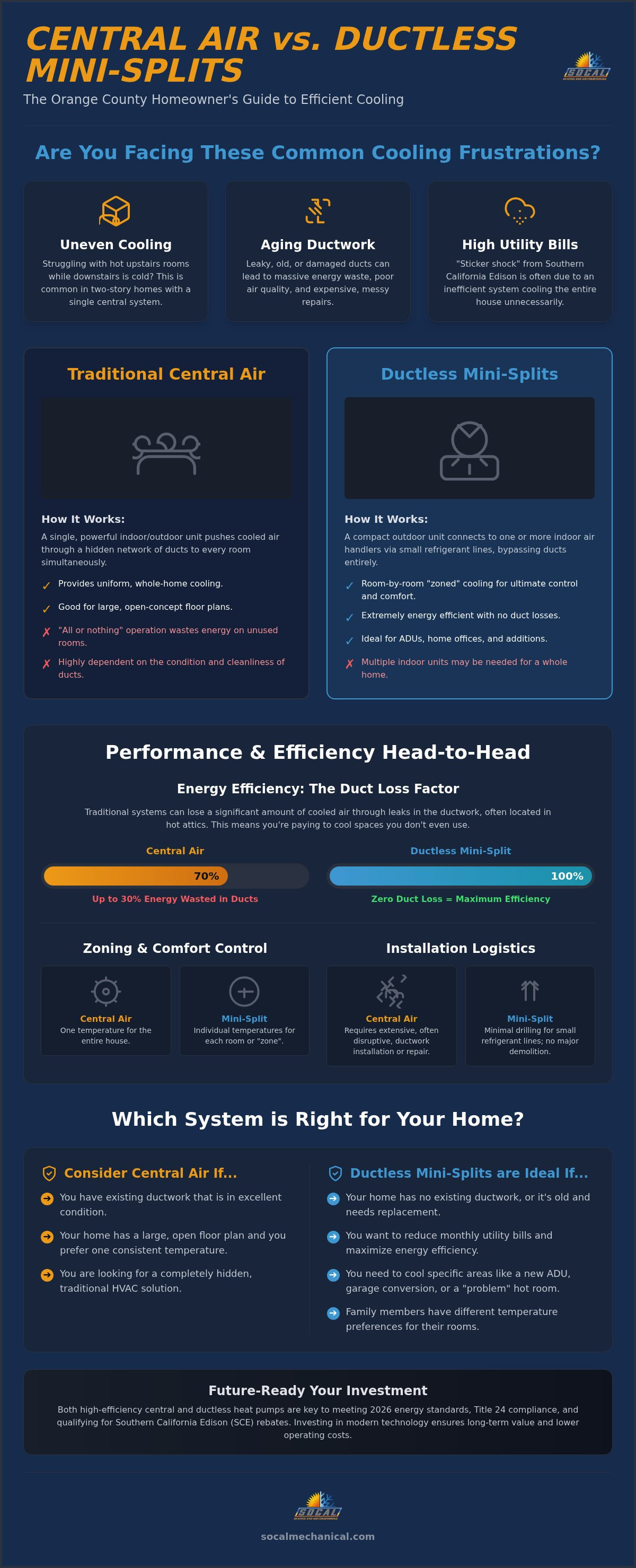
Central systems function as a unified, whole-home solution. They rely on an outdoor condenser, an indoor evaporator coil, and a powerful blower usually housed within a furnace or a dedicated air handler. This setup pushes cooled air through a hidden network of ducts to every room in the house. For larger, open-concept properties in Tustin or Yorba Linda, this remains a dependable way to maintain a uniform temperature across several thousand square feet.
The primary limitation of this traditional approach is its lack of precision. Most central systems are "all or nothing" configurations. You are often forced to cool the entire house just to make a single upstairs bedroom comfortable. Over time, this leads to unnecessary wear on the equipment and higher utility bills, especially in two-story homes where heat naturally accumulates on the upper floor.
The Rise of Ductless Mini-Split Technology
Ductless systems, commonly known as mini-splits, bypass the need for bulky metal ductwork entirely. These systems consist of a compact outdoor compressor connected to one or more indoor air handlers via small refrigerant lines. A major technical advantage is inverter technology. Unlike traditional units that turn fully on or off, mini-splits modulate their power output. They maintain a steady, low-energy flow to keep a room at a precise temperature without the noisy, energy-intensive restarts associated with older technology.
This precision makes mini-splits the gold standard for Accessory Dwelling Units (ADUs), garage conversions, or home offices. When homeowners evaluate the cost to install mini split Orange County configurations, they often find that the ability to cool specific "zones" provides a level of comfort that central air simply cannot match. Modern units have also evolved aesthetically. You can choose from sleek wall-mounted units, floor-standing models, or discreet ceiling cassettes that blend seamlessly into your home’s interior design.
Some Orange County residents even adopt a hybrid strategy. They maintain their central air for the main living areas while adding a mini-split to a primary suite or a converted attic. This approach provides the broad coverage of a traditional system alongside the surgical cooling precision of ductless technology, ensuring every corner of the home remains comfortable regardless of the outside temperature.
Performance Comparison: Efficiency, Zoning, and Comfort
Selecting an HVAC system involves more than just comparing cooling power. You must also consider how that power is delivered and how much it costs to keep the system running. While the upfront cost to install mini split Orange County systems is a primary concern for many homeowners, the performance differences in efficiency and zoning often dictate the long-term satisfaction with the investment.
Energy Efficiency and Your Monthly Bills
Efficiency is the most significant factor in managing high Southern California Edison bills. Traditional central air systems rely on a network of ducts that often run through unconditioned attic spaces. Research indicates that duct loss can waste up to 30% of a system's energy before the cooled air even reaches your living room. Because mini-splits are ductless, they eliminate this waste entirely, delivering air directly from the handler to the room.
Modern systems are measured by their SEER2 ratings. SEER2 stands for Seasonal Energy Efficiency Ratio 2, and it measures the cooling output of a system divided by its total energy usage, meaning a higher number results in lower monthly costs during Irvine’s peak summer heat. Many ductless units feature variable-speed compressors that modulate their output to match the exact cooling demand. This prevents the energy spikes caused by the frequent "on-and-off" cycles typical of older, single-speed central units. If you are considering an AC installation, evaluating these efficiency benchmarks is the first step toward lower utility bills.
Temperature Control and Zoning Capabilities
The "Thermostat War" is a familiar struggle in many two-story Orange County homes. Central air systems typically use one or two thermostats to control the entire house, which often leads to hot spots upstairs while the downstairs remains uncomfortably cold. Multi-zone mini-splits resolve this by providing individual comfort for every family member. Each indoor unit operates independently, allowing you to cool the kitchen during the day and the bedrooms at night without wasting energy on empty rooms.
While some homeowners try to mimic this control with "smart" vents in a central system, these can sometimes create backpressure issues that strain the blower motor. Mini-splits offer a more stable solution for precise temperature management. However, central air still holds an advantage in whole-house air filtration. Because it pulls air through a single, high-capacity filter, it is often more effective at removing dust and allergens from the entire home simultaneously. In contrast, mini-splits are prized for their quiet operation. The indoor air handlers operate at whisper-quiet decibel levels, whereas central air registers can produce noticeable airflow noise or whistling during peak operation.
Installation Logistics: Ductwork vs. Ductless
The physical installation process is where the theoretical benefits of an HVAC system meet the reality of your home's architecture. For many residents, the choice isn't just about cooling power; it's about how much disruption they're willing to accept. A traditional central air replacement is typically a non-invasive equipment swap that our team can often complete in a single day, provided your existing ductwork is in good condition. However, if your ducts are aging or undersized, you may face the "Ductwork Dilemma," where the expense of sealing or replacing hidden vents makes a ductless approach more practical.
When you evaluate the total cost to install mini split Orange County systems, it's important to understand the labor involved in multi-zone configurations. Unlike a simple central air swap, a multi-zone mini-split requires precise routing of refrigerant lines and communication wires through exterior walls to each indoor handler. While a single-zone unit might take only a few hours, a whole-home ductless project can span two to three days. This methodical approach ensures that every line-set is properly insulated and every connection is vacuum-tested for long-term reliability. Additionally, the compact footprint of mini-split condensers is a significant advantage for Orange County properties with narrow side-yards where a bulky central AC unit might not meet local clearance codes.
Challenges for Older Orange County Homes
Many mid-century properties in areas like Tustin and Anaheim present unique logistical hurdles. We often encounter narrow attic spaces that simply cannot accommodate the large, 12-inch or 14-inch insulated ducts required for modern high-efficiency central air. In some cases, older homes may still have original ductwork containing asbestos, which requires specialized abatement before any work can begin. For these homeowners, going ductless isn't just a preference; it's often the only way to achieve modern comfort without a massive construction project. You can find more detail on these specific local challenges in our Mini-Split Installation in Tustin: The Complete 2026 Homeowner’s Guide.
Modern Aesthetics and Placement Options
Ductless technology has evolved far beyond the basic white boxes of the past. You now have several placement options, including sleek wall-mounted units, floor consoles that sit near the baseboard, or recessed ceiling cassettes that stay nearly flush with the drywall. Professional installers use high-quality line-set covers, often called Slimduct, to hide the exterior piping and match your home's paint color. Before installation, we also evaluate your electrical panel. While mini-splits are highly efficient, a multi-zone system may require a dedicated 240-volt circuit, and we'll help you determine if your current panel has the capacity to support the new equipment without an expensive upgrade.
The Financial Investment: Upfront Cost vs. Long-Term Value
When you compare the upfront investment of these two systems, the choice often depends on whether you're replacing an existing unit or starting from scratch. Central air is frequently the more economical choice for a whole-house replacement if your home already has functional ductwork. A single outdoor condenser and indoor coil replacement is a streamlined process with lower labor requirements. In contrast, the total cost to install mini split Orange County systems for an entire home is typically higher because each room requires its own indoor air handler and dedicated refrigerant lines. However, this initial price difference is often balanced by the long-term energy savings and the absence of expensive duct repairs.
Maintenance requirements also differ between the two. Central systems need annual duct inspections to check for leaks or dust buildup, whereas mini-splits require regular filter cleaning for each individual unit. Both systems benefit from professional annual tune-ups to ensure the refrigerant levels and electrical components are functioning safely. From a property value perspective, modern HVAC upgrades are a strong asset during an appraisal. Orange County buyers increasingly prioritize high-efficiency heat pump technology and zoned comfort, which can make your home more competitive in the local real estate market.
Operating Costs and Energy Savings
The real financial benefit of ductless technology appears in your monthly utility statements. Because you can turn off units in unused rooms, you avoid the waste of cooling an entire house just to stay comfortable in one area. This is particularly effective under Southern California Edison's time-of-use (TOU) rates, where electricity prices spike during late afternoon and evening hours. By strategically managing your zones, you can achieve a significant return on investment over a 10-year period. For a deeper look at maximizing your system's lifespan and efficiency, read our AC Installation Orange County: A Homeowner’s Guide to Reliable Cooling (2026).
Rebates and Tax Credits in 2026
Navigating the financial incentives for 2026 requires careful attention to current regulations. It's important to know that the federal 25C tax credit for heat pumps expired on December 31, 2025, and is not available for systems installed in 2026. Similarly, major state programs like TECH Clean California have fully reserved their funding and aren't accepting new applications. However, Southern California Edison (SCE) continues to offer active rebates. Homeowners can currently receive $667 per ton for replacing a central AC and gas furnace with a qualifying heat pump. To qualify, your system must meet the 2025 California Building Energy Efficiency Standards (Title 24), which became effective on January 1, 2026. This code requires mandatory third-party verification of airflow and refrigerant charge. Our team provides the necessary documentation to ensure your mini split systems meet these strict requirements so you can claim every available utility incentive.
Decision Matrix: Which System Should You Choose?
The final choice between central air and a ductless system depends on your home's existing structure and your specific comfort goals. There isn't a one-size-fits-all answer, but there are clear indicators for which technology will serve you best. When calculating the total cost to install mini split Orange County configurations, we look at the specific layout of your home to ensure you aren't paying for more capacity than you actually need. A professional load calculation is the only way to be 100% sure about the sizing, as an oversized system will cycle on and off too frequently, leading to premature wear and higher energy bills.
- Choose Central Air if: You have existing, functional ductwork that is clean and properly sized. It remains the most cost-effective way to provide uniform cooling across a large, traditional floor plan.
- Choose a Mini-Split if: You are adding a new room, converting a garage, or live in a home with a flat roof or limited attic space. It's also the ideal solution for resolving persistent "hot spots" that your central system can't reach.
- The Hybrid Approach: Many homeowners find the "best of both worlds" by keeping their central air for the main living areas while adding a single-zone mini-split to a primary suite. This allows you to keep the bedroom ice-cold at night without paying to cool the entire house.
Neighborhood-Specific Recommendations
In Irvine, many condo developments have strict HOA regulations regarding the placement and noise levels of outdoor equipment. Mini-split condensers are significantly smaller and quieter than traditional central units, making them much easier to clear through architectural committees. For historic homes in Tustin, preserving the original lath and plaster walls is often a priority. Ductless systems allow us to provide modern cooling without the invasive construction required to hide large metal ducts behind old walls.
New Accessory Dwelling Units (ADUs) and garage conversions are almost always better served by ductless technology. These spaces are often built with high insulation standards and don't require the massive airflow of a central system. A small, high-efficiency mini-split provides the exact amount of cooling needed for these compact living spaces while taking up virtually no floor space.
The SOCAL Difference: Integrity in Every Recommendation
Our team believes in a "no-surprises" approach to home comfort. We don't use high-pressure tactics or try to sell you the most expensive equipment on the market. Instead, we act as a straight-shooting guide to help you protect your budget and your comfort. We focus on transparency, providing a methodical explanation of why we recommend a specific system for your Tustin or Anaheim property. We've served the local community since 2003, and we value our reputation for honesty over a quick sale. If your existing ducts are in great shape, we'll tell you. If a mini-split is the only logical choice for your room addition, we'll explain exactly why. Schedule a professional comfort consultation with SOCAL Heating and Air Conditioning today!
Investing in Your Long-Term Home Comfort
Deciding on a new cooling system is a significant step toward improving your home's efficiency and your family's comfort. As we've explored, the choice between traditional central air and modern ductless units depends largely on your home's architecture and your specific cooling habits. While central air remains a dependable standard for many, the flexibility of zoned cooling is often a game-changer for reducing monthly utility bills. When you evaluate the total cost to install mini split Orange County systems, remember that the long-term value lies in energy savings and the removal of the "ductwork dilemma" found in older properties.
At SOCAL Heating and Air Conditioning, we've focused on providing honest, reliable service to Tustin and Irvine since 2003. As a licensed, bonded, and insured contractor, we specialize in Title 24 compliant installations that meet the latest 2026 standards. We believe in a straightforward, no-surprises approach that always puts your needs first. Get a transparent, no-obligation quote for your Orange County home cooling project. We're ready to help you find the perfect balance of performance and value for your home. We look forward to making your space comfortable again.
Frequently Asked Questions
Is a mini-split more expensive to install than central air in Orange County?
Generally, a whole-home mini-split system has a higher upfront cost than a central AC replacement if your home already has functional ductwork. The installation requires more labor to run individual refrigerant lines and electrical connections to each room. However, if your project involves a single-zone addition or a home without existing ducts, the mini-split is often the more economical and less invasive choice.
Can a mini-split really cool a whole house in Southern California?
Yes, a multi-zone mini-split system is fully capable of cooling an entire home, even during the peak heat of an inland summer. By placing indoor units in every major living area, you create a network of independently controlled zones. This ensures that every room reaches your desired temperature without the "hot spots" often found in traditional central air configurations.
How long do mini-split systems last compared to central AC units?
Most high-quality mini-split systems have an expected operational lifespan of 12 to 15 years, which is very similar to modern central AC units. Regular professional maintenance is the most important factor in reaching this milestone. Because mini-splits use inverter technology to run at steady, lower speeds, they often face less mechanical wear than traditional systems that frequently cycle on and off.
Do I need to clean the ducts if I switch from central air to a mini-split?
No, you don't need to maintain or clean your old ductwork once you transition to a ductless system. Since mini-splits deliver air directly from the indoor handler to the room, the existing ducts become obsolete and can remain undisturbed in your attic. This is a significant advantage for homeowners looking to eliminate the dust and allergen buildup often associated with aging duct systems.
Are mini-splits quiet enough for a bedroom in a quiet OC neighborhood?
Yes, mini-splits are designed for near-silent operation and are often much quieter than the air rushing through a central vent. Most indoor units operate between 19 and 30 decibels, which is quieter than a soft whisper. This makes them an ideal solution for bedrooms or home offices where maintaining a peaceful environment is a top priority.
What is the most energy-efficient HVAC system for a home in Irvine or Tustin?
High-efficiency heat pump mini-splits are currently the most energy-efficient cooling and heating technology available for residential use. These systems frequently reach SEER2 ratings that exceed the minimum requirements for new California installations. By removing the energy waste caused by duct leakage, they provide a more direct and efficient way to manage your home's climate.
Will installing a mini-split lower my SCE bill significantly?
Most homeowners notice a reduction in their monthly electricity bills after switching to ductless technology, particularly when replacing an older central unit. The primary savings come from the ability to turn off cooling in unoccupied rooms. When you consider the total cost to install mini split Orange County systems, the monthly reduction in your SCE statement is a major factor in the long-term value of the upgrade.
How many indoor units can I connect to one outdoor mini-split condenser?
Depending on the capacity of the outdoor unit, you can typically connect between two and eight indoor air handlers to a single multi-zone condenser. This allows you to customize the comfort levels in different areas of your home while only maintaining one outdoor component. Our team will help you determine the right number of units based on your home's square footage and layout.


