

Most homeowners don't realize that an air conditioner installed just a few years ago might already fail to meet California’s strict 2026 energy standards. If you are planning an AC installation Orange County, you are likely facing a market filled with new regulations, changing refrigerants, and unpredictable quotes. It is understandable to feel hesitant when the goal is simply to keep your family comfortable without a surprise bill or a system that fails when the Santa Ana winds kick in.
We believe you deserve a straightforward path to a cooler home. This guide offers a transparent look at the latest Title 24 requirements, including the mandatory shift to R-454B and R-32 refrigerants and the 14.3 SEER2 efficiency minimums. You will learn how a methodical approach to ductwork and HERS testing ensures your new system runs quietly and efficiently for years. By the end, you will have the clarity needed to make an investment that lowers your monthly costs and provides genuine peace of mind.
Key Takeaways
- Understand how Orange County’s distinct microclimates, from coastal moisture to inland heat, influence the specific cooling capacity your home requires.
- Learn why a methodical, transparent approach to AC installation Orange County ensures your project stays on schedule without hidden costs or property damage.
- Compare the benefits of traditional central air against ductless mini-split systems to find the most efficient fit for your property's layout.
- Discover why professional ductwork evaluation is critical to ensuring your new cooling system doesn't lose efficiency through leaks or poor insulation.
- Identify the factors that contribute to long-term value, focusing on systems that provide consistent comfort while lowering your monthly utility bills.
Understanding AC Installation in Orange County’s Unique Climate
In Southern California, a new air conditioner is more than a simple appliance purchase. Professional AC installation Orange County involves a complex integration of electrical work, airflow management, and precision calibration. It isn't just about swapping out a metal box in your backyard. It's about integration. Every component of your Heating, ventilation, and air conditioning (HVAC) system must work in harmony with your home's unique structure to provide lasting comfort.
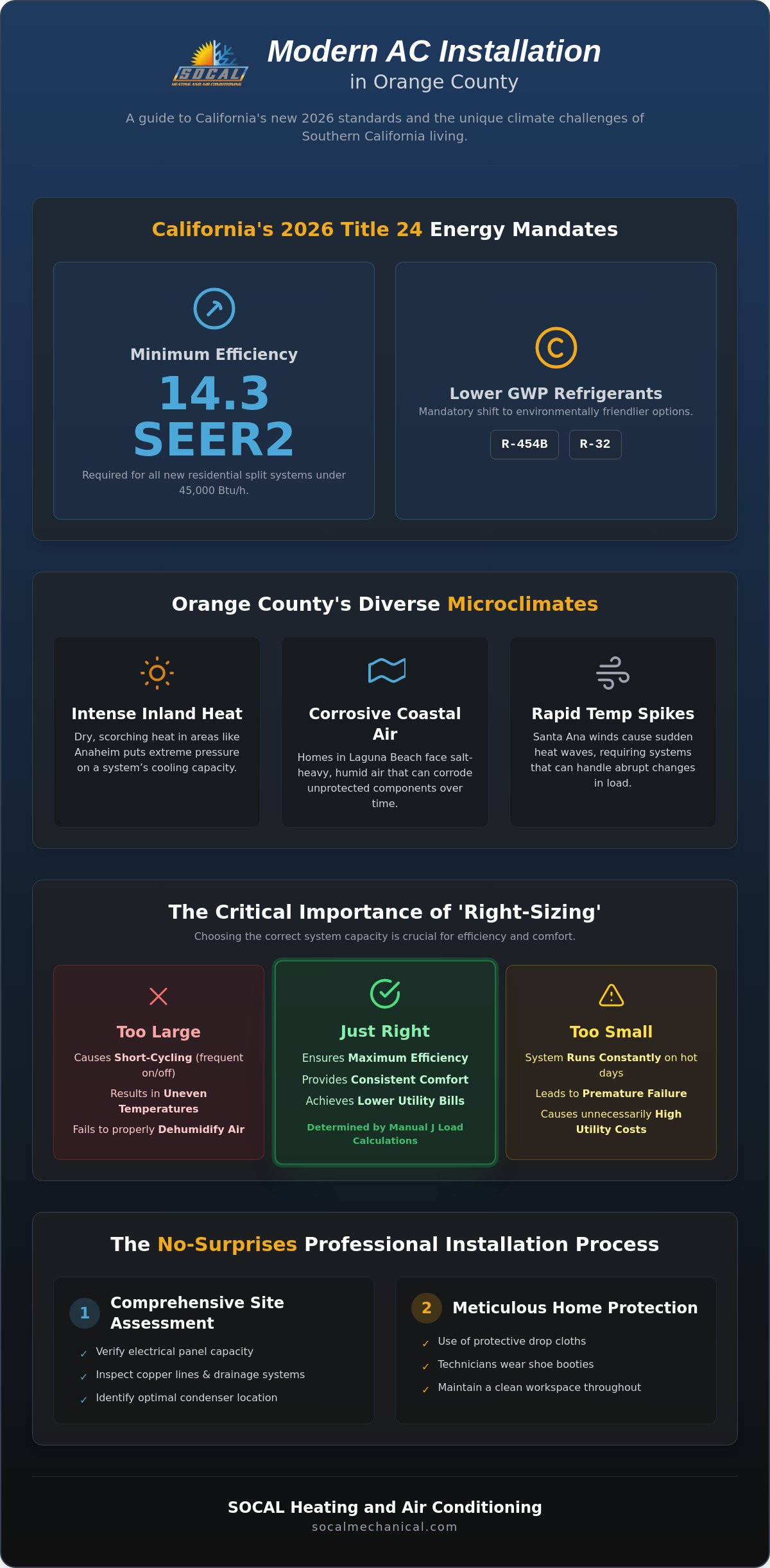
Orange County presents a distinct challenge because of its varied microclimates. A home in Anaheim deals with intense, dry inland heat that puts immense pressure on a system's cooling capacity. Conversely, a residence in Laguna Beach must contend with coastal humidity and salt-heavy air that can corrode components if they aren't properly protected. Our dry air means we require systems that can handle rapid temperature spikes during Santa Ana wind events without failing under the load. Choosing a partner for AC installation Orange County means finding someone who understands these regional shifts and how they impact your equipment's lifespan.
The regulatory landscape has also shifted significantly. As of January 1, 2026, the updated Title 24 Building Energy Efficiency Standards apply to all new HVAC permits. These rules make professional installation more critical than ever. Modern systems now use lower Global Warming Potential (GWP) refrigerants, such as R-454B or R-32, which require specific handling and tools. An expert-led installation ensures your home remains compliant with state law while maximizing the performance of these advanced technologies.
Why 'Right-Sizing' Matters for OC Homes
Selecting the correct capacity for your home is a balance of science and local experience. If a unit is too large, it turns off and on too frequently, a process known as short-cycling. This leads to uneven temperatures and prevents the system from properly dehumidifying your air. If it's too small, it will struggle to maintain comfort during a 100-degree day in Tustin, leading to premature mechanical failure and high utility costs. Manual J Load Calculations are the industry gold standard for determining the exact cooling capacity your specific home requires.
Energy Efficiency Standards in 2026
The latest energy codes require residential split systems under 45,000 Btu/h to meet a minimum efficiency of 14.3 SEER2. These ratings measure how much cooling you get for every watt of electricity used. While high-efficiency systems may require a larger initial investment, they typically pay for themselves through lower Irvine utility bills. We are also seeing a major shift toward heat pumps. These systems offer an electrified solution for both heating and cooling, providing a versatile option as California moves toward more sustainable home energy landscapes.
The SOCAL Installation Process: A Methodical, No-Surprises Journey
We believe that the best professional relationship is built on a foundation of absolute clarity. When you schedule an AC installation Orange County, you shouldn't have to worry about hidden fees or shifting timelines. Our approach begins with a comprehensive roadmap provided before any work starts. This document outlines every phase of the project, from the initial equipment delivery to the final quality checks. It's our way of ensuring you feel like a partner in the process rather than just a customer.
Our technicians respect your property as if it were their own. This means using protective drop cloths and shoe booties in every residence, whether we're working in a modern Irvine condo or a traditional family home in Mission Viejo. We maintain a clean workspace to ensure that the only evidence of our visit is a perfectly functioning cooling system. This commitment to home protection is a core part of our "no-surprises" philosophy, ensuring that your home remains as pristine as we found it.
Step 1: Comprehensive Site Assessment
Every successful project relies on a thorough understanding of the home's existing infrastructure. In older neighborhoods like Yorba Linda or Orange, we pay special attention to the electrical panel to ensure it can support the new minimum energy efficiency standards without overloading. We also inspect the copper line sets and drainage systems for potential leaks or blockages that could cause long-term issues. Finally, we identify the best location for the outdoor condenser to minimize noise for both you and your neighbors.
Step 2: Precision Installation and Calibration
Once the assessment is complete, the technical work begins with surgical precision. We use specialized pumps to vacuum the entire system, removing every trace of moisture and debris that could damage the compressor over time. Vacuuming is a critical but often skipped step; we spend the necessary time to pull a deep vacuum to protect the internal components from chemical reactions. We then verify the refrigerant charge to ensure it matches the manufacturer's exact specifications for peak efficiency. Our team also calibrates your thermostat to ensure it integrates seamlessly with your existing smart home devices. If you have questions about how these steps impact your home's comfort, you can learn more about our professional approach to quality craftsmanship.
The journey doesn't end when the unit is bolted down. We perform a series of post-installation tests to verify that the airflow and cooling output meet the high standards we set for ourselves. This methodical process removes the guesswork and ensures that your investment in AC installation Orange County delivers reliable cooling for many years to come.
Selecting the Right Cooling Solution for Your Property
Selecting the right technology for your property is a decision that balances architectural constraints with your family’s lifestyle. In a diverse region like ours, a one-size-fits-all approach rarely works. Whether you are upgrading a suburban estate or retrofitting a workspace, understanding the available hardware is the first step in a successful AC installation Orange County.
Central air conditioning remains the most common choice for detached family homes, particularly in established neighborhoods like Mission Viejo. These systems utilize a network of ducts to provide consistent, whole-home cooling. For many, this is the most cost-effective way to manage large square footage. However, if your home lacks existing ductwork or you are adding a new room, ductless mini-split systems offer a highly efficient alternative. These units allow for precise temperature control in individual rooms, making them a favorite for historic homes in Orange where preserving the original architecture is a priority.
For those exploring their options, this HVAC buying guide provides a helpful foundation for comparing different system types. Beyond standard cooling, we often recommend whole house fans as a natural supplement. These fans pull cool evening air into the home and exhaust hot air through the attic, taking full advantage of the refreshing Orange County breeze to reduce the load on your primary air conditioner. This combination is an excellent way to maintain comfort while keeping energy consumption in check.
Central Air vs. Ductless Mini-Splits
The choice between central air and ductless systems often comes down to installation complexity. Central units require a functional duct network, which acts as the distribution system for your home. Ductless systems, while sometimes carrying a higher upfront cost per unit, eliminate the energy loss associated with leaky ducts. They are ideal for multi-generational households because they offer superior zoning; one person can keep their bedroom cool while the rest of the house remains at a different temperature. From an aesthetic standpoint, central air is nearly invisible, while mini-splits involve sleek, wall-mounted units in each cooled space.
Commercial Rooftop HVAC Solutions
Commercial properties in Orange County have unique demands that residential systems aren't designed to handle. Rooftop units (RTUs) are the standard for retail spaces and offices because they save valuable ground space and simplify maintenance access. Managing airflow in these large-scale environments requires a specialized understanding of building pressure and ventilation. Because these units are constantly exposed to the elements, preventative maintenance is non-negotiable for ensuring their longevity. A well-planned AC installation Orange County for a business must account for the specific occupancy loads and heat-generating equipment found within the building to ensure the environment remains productive and comfortable.
Evaluating the Cost and Long-Term Value of New HVAC
When considering AC installation Orange County, it's natural to focus on the initial estimate. However, the most reliable way to measure your investment is through the total cost of ownership over the next fifteen years. A "cheap" installation often leads to higher utility bills and frequent repairs, while a high-quality system provides consistent comfort and significant savings. By focusing on value rather than just the entry price, you protect your home from the hidden costs of poor craftsmanship and inefficient operation.
Modern cooling systems are designed to drastically reduce your monthly Southern California Edison (SCE) bills. Moving from an older 10 SEER unit to a new 14.3 SEER2 or 16 SEER2 system can lower energy consumption significantly. Additionally, maintaining a consistent professional maintenance schedule is essential for protecting your manufacturer's warranty. Most brands require documented annual service to keep their coverage active. This proactive care ensures that your AC installation Orange County remains a stable asset rather than a liability.
In 2026, the financial landscape for HVAC has changed. While the federal 25C tax credit expired at the end of 2025, homeowners can still find value through local utility programs. Southern California Edison offers rebates for high-efficiency heat pumps, including up to $667 per ton for ducted systems and over $1,100 per ton for certain mini-split configurations. Because statewide programs like TECH Clean California are currently fully reserved, these utility-specific rebates represent the most reliable way to offset your initial investment.
Factors Influencing Your Installation Investment
Several variables determine the scope of your project. The capacity of the unit and its SEER2 rating are primary drivers, but the physical environment matters just as much. Installing a system in a cramped attic or on a steep roof requires more labor and specialized equipment than a ground-level closet installation. We also evaluate your existing ductwork and electrical panels to ensure they can handle the requirements of modern equipment without causing safety risks or performance bottlenecks.
Maximizing ROI Through Energy Efficiency
Investing in an 18+ SEER2 system often results in a shorter payback period because of the dramatic reduction in energy waste during intense heatwaves. Smart cooling technology, such as programmable thermostats, adds another layer of savings by adjusting temperatures based on your daily routine. It is also a documented fact that a precision-led installation can extend the operational life of your system by up to five years, preventing the mechanical strain caused by poor airflow or incorrect refrigerant levels. If you are ready to explore the best options for your home, contact our team for a transparent assessment of your cooling needs.
Why Professional Ductwork is the Secret to Efficient Cooling
A high-performance air conditioner is only as effective as the network of ducts it feeds. Think of your ductwork as the "lungs" of your home. If these passages are restricted, leaking, or poorly insulated, even the most advanced AC installation Orange County will fail to deliver the comfort you expect. Many homeowners invest in a new outdoor unit only to find that their energy bills remain high because the cooled air is escaping into the attic or crawlspace before it ever reaches the living room.
In Orange County, we frequently encounter duct systems that were not designed for the demands of modern high-efficiency equipment. Common issues include undersized return vents that starve the system of air and old insulation that has degraded over decades of Southern California heat. When we perform an AC installation Orange County, we don't treat the ductwork as an afterthought. We integrate a thorough inspection and repair process to ensure your new system can breathe properly. This direct link between duct integrity and performance is also critical for indoor air quality, as sealed ducts prevent dust, allergens, and attic debris from being pulled into your breathing air.
Signs Your Ducts are Sabotaging Your New AC
It is frustrating to install new equipment only to experience the same old comfort issues. If you notice significant temperature differences between rooms in your Irvine home, it's a clear sign of airflow imbalance. You might also hear a distinct whistling sound when the system kicks on, which often indicates that your returns are too small for the unit's capacity. If your energy bills stay high despite having a brand-new, high-SEER2 system, your ducts are likely the culprit, leaking expensive cooled air into unconditioned spaces of your home.
The SOCAL Advantage in Air Distribution
Our team provides custom solutions tailored to the diverse architectural styles found throughout the county. Whether you live in a mid-century modern home with tight attic clearances or a newer multi-story residence, we design air distribution paths that maximize efficiency. We use a methodical approach to sealing every joint and connection with high-quality mastic and insulation. This ensures that every bit of cooling you pay for actually reaches your family. You can learn more about our ductwork services and how we optimize your home's total climate control system. By addressing the "lungs" of the home alongside the equipment, we provide a truly reliable cooling solution that stands the test of time.
Securing Your Home's Long-Term Comfort
Choosing a new cooling system is a significant decision that impacts your home's value and your family's daily comfort for over a decade. We've explored how matching equipment to your specific microclimate and ensuring your ductwork is sealed and efficient are the true secrets to a high-performing system. With the 2026 energy standards now in effect, the precision of your AC installation Orange County matters more than ever to ensure compliance and maximize your utility savings.
Since 2003, we've served our neighbors across the county from our home base in Tustin. As specialists in both advanced cooling hardware and professional ductwork, we focus on a transparent, methodical process that removes the stress from home improvements. We are here to help you navigate these technical choices with honesty and local expertise. Schedule Your Transparent AC Installation Quote Today to begin your journey toward a more efficient, reliably cooled home. We look forward to helping you achieve lasting peace of mind.
Frequently Asked Questions
How much does AC installation cost in Orange County in 2026?
The total investment for a new system is influenced by the unit’s capacity, its SEER2 efficiency rating, and the complexity of your home’s existing ductwork. In 2026, factors such as the mandatory transition to lower Global Warming Potential refrigerants and stricter Title 24 compliance also play a role in the project scope. We provide transparent, detailed roadmaps for every project to ensure you understand the value and long-term savings of your specific system before any work begins.
How long does a typical air conditioning installation take?
A standard residential AC installation Orange County typically takes between eight to twelve hours to complete. If your project requires extensive ductwork repair or a new electrical panel to meet modern standards, the process may extend into a second day. Our team works methodically to minimize disruption to your schedule while ensuring every component is calibrated according to manufacturer specifications for peak performance from day one.
Do I need to replace my furnace when I get a new AC unit?
Replacing your furnace alongside your new AC is usually the most logical choice because it ensures both units share compatible blower technology. Modern high-efficiency air conditioners require specific airflow levels that older furnace blowers often cannot provide. By updating both systems at once, you avoid the risk of a mismatched system that fails to meet the 14.3 SEER2 efficiency standards required by current California law.
What are the current SCE rebates for energy-efficient AC units?
Southern California Edison provides specific rebates for homeowners who switch to high-efficiency heat pumps. You can receive $667 per ton for ducted systems that meet a 16 SEER2 rating when replacing a traditional AC and gas furnace. For ductless mini-splits, the rebate can reach up to $1,144.80 per ton depending on the equipment being replaced. These programs are designed to encourage home electrification and provide significant long-term value for residents.
Is a permit required for AC installation in Tustin or Irvine?
Building permits are required for all HVAC replacements in Tustin and Irvine to ensure the installation meets the 2025 California Energy Code. This process includes mandatory third-party HERS testing to verify that duct leakage is 5% or less and that the system achieves a minimum airflow of 350 CFM per ton. While the permit adds a step to the process, it protects you by confirming the work is safe and energy-efficient.
What is the difference between a heat pump and a traditional AC?
A heat pump is an all-electric system that provides both heating and cooling, whereas a traditional AC requires a separate furnace for heat. Heat pumps are becoming increasingly popular in Orange County because our mild winters allow them to operate at peak efficiency year-round. This technology aligns with California's push for home electrification and often qualifies for more substantial utility rebates than traditional split systems that rely on natural gas.
How often should I have my new AC system serviced after installation?
You should schedule a professional tune-up for your new system at least once per year to maintain its efficiency and protect your investment. Annual service is often a requirement for keeping your manufacturer's warranty valid; neglecting this can lead to expensive out-of-pocket repairs later. Regular inspections allow us to identify minor issues, such as small refrigerant leaks or electrical wear, before they lead to a system failure during an intense heatwave.
Can I install a quiet whole house fan along with my new AC?
A quiet whole house fan is a perfect supplement to a new AC installation Orange County because it takes advantage of our cool coastal evenings. These fans exhaust hot indoor air through the attic and pull in fresh air from outside, allowing you to turn off your AC once the sun goes down. This combination significantly reduces your monthly utility bills and extends the life of your cooling equipment by reducing its daily workload.


