
If you replaced your commercial cooling system tomorrow, would your building's roof actually support the weight of the high-efficiency equipment required by the latest 2026 energy codes? For many local entrepreneurs, a rooftop HVAC unit installation in Orange County feels like a gamble where the stakes involve both your budget and your daily operations. You want a system that works reliably, yet the fear of unexpected structural repairs or business downtime often makes the process feel overwhelming.
We understand that you need transparency and a partner who treats your bottom line with respect. This guide simplifies the technical side of commercial installations by providing an honest look at the logistics and local regulations you need to know. You will learn exactly how to manage the transition to new refrigerants, ensure compliance with California Title 24 standards, and maintain your building's structural integrity without disrupting your workflow. We have designed this preview to give you the clarity needed to make an informed decision for your business's long-term comfort and peace of mind.
Key Takeaways
- Discover why packaged rooftop units are the standard for local commercial properties and how they help you maximize your building's interior footprint.
- Navigate the logistics of a rooftop HVAC unit installation Orange County with a clear timeline that prioritizes structural integrity and minimizes business downtime.
- Apply the 50% rule to decide whether to repair or replace your aging system based on long-term ROI and 2026 energy efficiency standards.
- Learn the importance of precise system sizing and indoor air quality upgrades to maintain a healthy, productive environment for your employees and customers.
- Gain peace of mind by understanding how to meet strict California Title 24 compliance through a transparent, methodical installation process.
Understanding Rooftop HVAC Units (RTUs) in the Orange County Climate
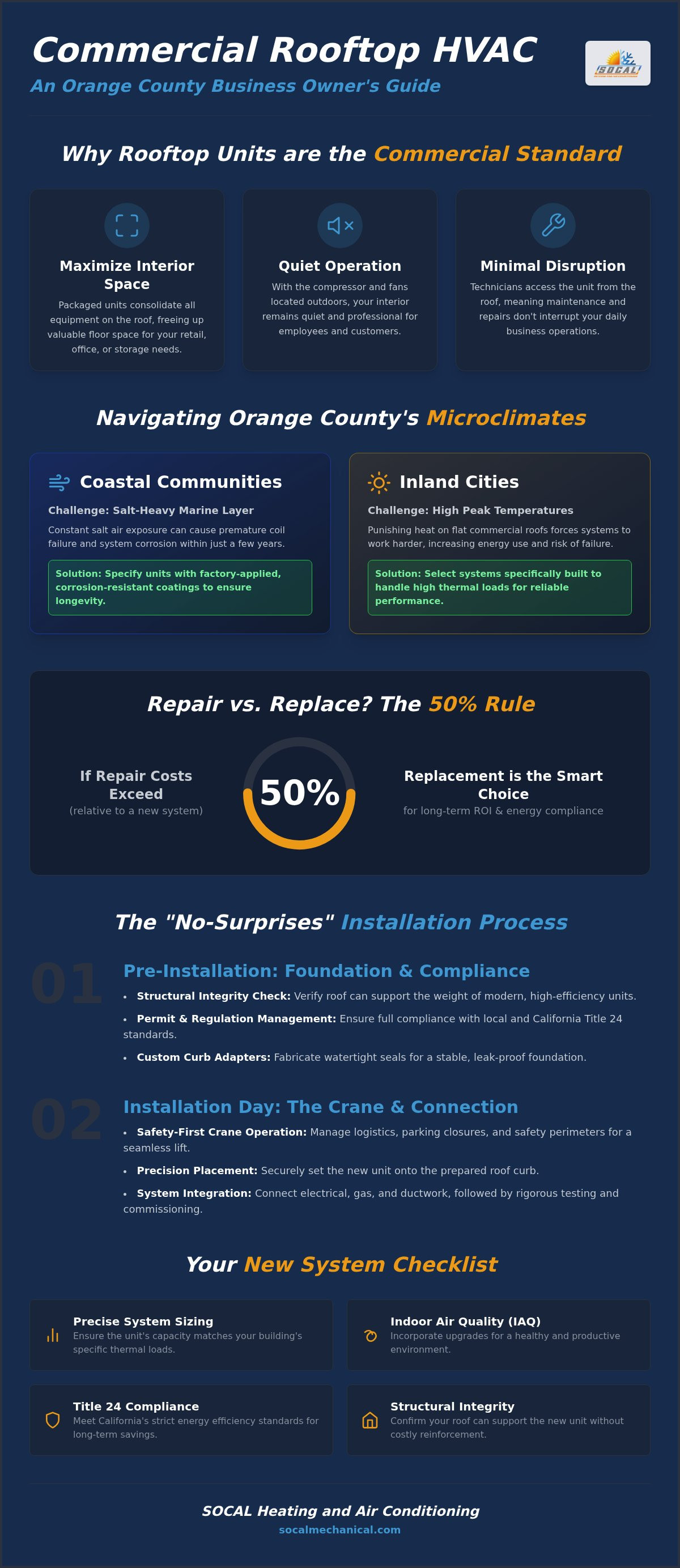
A rooftop unit, often called an RTU, is a self-contained system that houses all the components of Heating, ventilation, and air conditioning (HVAC) in one weather-resistant cabinet. For business owners planning a rooftop HVAC unit installation Orange County, these "packaged" systems are the industry standard because they consolidate the heating and cooling elements into a single footprint. This design eliminates the need for bulky indoor equipment, allowing you to maximize every square foot of your commercial floor plan for retail, storage, or office use.
Orange County isn't a monolith. Our local climate requires a nuanced approach to equipment selection that accounts for your specific neighborhood. In coastal communities like Laguna Hills and Mission Viejo, the salt-heavy marine layer is a constant factor. Without proper protection, salt air can lead to premature coil failure within just a few years. Meanwhile, inland cities like Anaheim and Orange experience much higher peak temperatures. On a flat commercial roof, the surface heat can be punishing. A system that isn't built to handle these specific thermal loads will work harder, consume more energy, and likely fail sooner than expected. Selecting the right unit isn't just about the cooling capacity; it's about choosing a system that matches the structural capabilities of your building and your neighborhood's microclimate.
Packaged Systems vs. Split Systems for Commercial Use
Commercial properties in Irvine and surrounding areas benefit from the noise-reduction qualities of RTUs. Because the compressor and fans are located outdoors and above the ceiling plane, the interior remains quiet and professional. Maintenance access is another significant advantage. Our technicians can access the unit directly from the roof, which means we don't have to bring ladders or heavy parts through your lobby or workspace. This methodical approach keeps your business running smoothly while we ensure your system stays in peak condition. Properly integrated ductwork is also essential for these units to move air efficiently, ensuring every corner of your facility remains comfortable.
Environmental Challenges for OC Rooftops
Managing the environmental stress on a roof is a critical part of a successful installation. High UV exposure in Southern California can degrade standard wiring and plastic components if they aren't properly shielded. For properties near the ocean, we prioritize units with factory-applied coatings that resist corrosion. We also focus on the role of economizers. These components take advantage of the cool evening breezes common in Orange County by pulling in outside air to cool the building. It's a simple, logical way to reduce the load on your compressor and lower your monthly utility costs. By accounting for these environmental factors during your rooftop HVAC unit installation Orange County, you ensure your investment provides dependable service for years to come.
The Logistics of Rooftop HVAC Unit Installation: A Step-by-Step Guide
Moving a multi-ton piece of equipment onto a commercial roof requires more than just a truck and a ladder. A successful rooftop HVAC unit installation Orange County depends on a methodical timeline that starts weeks before the equipment arrives. We prioritize a "no-surprises" approach to ensure your building remains secure and your business stays open during the transition. By following a logical, step-by-step process, we remove the uncertainty that often accompanies large-scale mechanical projects.
Pre-Installation: Permits and Structural Integrity
The process begins with a rigorous check of your building's structural capacity. Modern units, particularly those meeting the 2026 Title 24 standards, often weigh more than the systems they replace. When planning a rooftop HVAC unit installation Orange County, we coordinate with experts to verify that your roof can handle the load without reinforcement. If the new unit has a different footprint, we utilize custom-fabricated curb adapters. These adapters provide a watertight transition between the new unit and the existing roof opening, which prevents leaks and ensures a stable, long-term foundation.
Installation Day: The Crane and the Connection
"Crane Day" is the most visible part of the project. We manage the logistics of parking lot closures and safety perimeters to minimize disruption to your staff and customers. Safety is non-negotiable; our teams adhere strictly to OSHA fall protection requirements to protect both our technicians and your property. Once the crane lifts the old unit away and sets the new one in place, the focus shifts to precision. We verify that the unit is perfectly level and that the seal to the roof curb is airtight. Our technicians then connect the unit to your existing commercial ductwork, ensuring the transition is seamless to maintain optimal static pressure.
Post-Installation: Verification and Cleanup
After the mechanical work is done, we enter the verification phase. This includes mandatory HERS testing and final inspections to satisfy local building departments and energy codes. We also handle the responsible removal and recycling of your old equipment and any hazardous refrigerants. A final airflow balance test is performed to confirm that every zone in your building receives the exact volume of conditioned air required for occupant comfort. If you have questions about the specific timeline for your property, our team can provide a detailed project walkthrough based on your building's unique layout.
Rooftop Unit Replacement vs. Repair: Making the Financial Choice
Deciding whether to fix an aging system or invest in a new one is a common challenge for local business owners. You want to avoid wasting capital on a failing unit, but you also need to ensure your decision supports your long-term budget. We use a straightforward "50% Rule" to provide clarity. If the cost of a single repair exceeds 50% of the system's total value, or if the unit is more than 15 years old, a full replacement is almost always the more logical financial path. This is especially true as energy costs continue to rise and older equipment becomes less efficient over time.
The hidden costs of maintaining obsolete equipment often outweigh the initial price of a rooftop HVAC unit installation Orange County. For example, older systems manufactured before 2025 likely use R-410A refrigerant. Because of new environmental mandates, this refrigerant is becoming more expensive and difficult to source. A small leak in an old unit can lead to hundreds of dollars in recharging costs alone. Additionally, we always evaluate the condition of your commercial ductwork. If your ducts are leaking significantly, they can force your unit to work 20% harder, which negates the benefits of even the most expensive repairs.
Signs Your RTU is Nearing End-of-Life
Mechanical fatigue often shows itself through physical symptoms. If your employees complain about excessive noise or vibrations coming from the ceiling, it's a sign that the compressor or blower motor is failing. Inconsistent temperatures are another red flag. When one zone of your office is sweltering while another is freezing, the unit's internal components are likely struggling to manage airflow correctly. If you've had to call for repairs more than twice in the last 24 months, your system is telling you that it's no longer dependable.
ROI of High-Efficiency SEER2 Units
Modern rooftop systems offer a significant return on investment through improved efficiency. New units meeting the 2026 SEER2 standards utilize variable-speed compressors that adjust their output based on the actual cooling load of your building. This prevents the energy spikes caused by older units constantly cycling on and off. You can find more details on how these systems impact your bottom line in our guide on Commercial HVAC Orange County: Managing Comfort Costs. Beyond monthly utility savings, high-efficiency upgrades often qualify for federal tax credits. For instance, qualifying heat pumps can earn up to $2,000 in credits, while high-efficiency central AC units may qualify for $600, helping to offset the upfront cost of your installation.
Key Considerations for Selecting the Right Rooftop HVAC Unit
Selecting the right equipment is a balancing act between initial cost and long-term performance. During a rooftop HVAC unit installation Orange County, we look beyond the square footage of your building to evaluate your actual occupancy rates. A medical facility in Laguna Woods has different cooling needs than a distribution center in Lake Forest, even if the buildings have identical footprints. We also account for the specific micro-climate of your location. Properties in Laguna Niguel require units with specialized coatings to resist salt air corrosion, while facilities in Anaheim need systems designed to handle intense afternoon heat without failing. If you choose a unit with too much tonnage, you'll experience "short cycling," which prevents the system from removing humidity and puts unnecessary strain on the compressor.
We often recommend heat pumps for Orange County businesses because our winters are mild and rarely require the intense heat of a gas furnace. These systems align with California's push toward electrification and offer a logical way to streamline your utility bills. However, some facilities still benefit from gas and electric packaged units if they have specific industrial heating requirements or existing infrastructure that makes a total conversion impractical. Our goal is to provide a straightforward recommendation that protects your budget while ensuring your staff stays comfortable year-round.
Energy Efficiency and Title 24 Compliance
The 2026 standards have raised the bar for commercial efficiency. For new installations, central air conditioners must meet a minimum SEER2 rating of 14.3, while heat pumps require a SEER2 of 15.2. We integrate economizers into these systems to meet California energy standards. These devices pull in cool air from the outside during the morning or evening, which significantly reduces the time your compressor needs to run. Title 24 compliance for rooftop units is a state-mandated regulatory framework that establishes minimum energy efficiency and ventilation standards for all commercial HVAC installations in California.
Indoor Air Quality and Ventilation Features
A modern RTU does more than just cool the air; it manages the health of your indoor environment. We prioritize high-MERV filters that capture fine particulates and allergens, which is essential for maintaining a productive workspace. We also utilize demand-controlled ventilation (DCV) sensors. These sensors monitor CO2 levels and adjust the amount of fresh air coming into the building based on real-time occupancy. This ensures you don't waste energy cooling an empty room while providing plenty of fresh air during a busy afternoon. Properly designed ductwork is the final piece of the puzzle, as it ensures this clean, conditioned air reaches every workstation without loss of pressure.
If you are ready to explore equipment options that match your building's specific needs, you can request a commercial system evaluation from our team.
Professional Rooftop HVAC Solutions with SOCAL Heating and Air Conditioning
SOCAL Heating and Air Conditioning has operated with a simple, honest philosophy since we opened our doors in Tustin in 2003. We know that as a business owner, you don't have time for vague quotes or high-pressure sales tactics. Our "straight-shooting" approach means we provide clear, methodical plans for every rooftop HVAC unit installation Orange County. We treat your commercial property like it belongs to a neighbor, ensuring that every recommendation we make is grounded in long-term value rather than a quick profit. Our goal is to provide peace of mind through transparent communication and reliable craftsmanship.
Our project management process is designed to remove the stress of large-scale mechanical work. We provide transparent pricing from the start, so you aren't surprised by hidden fees during the final inspection. Because we specialize in commercial ductwork and indoor air quality, we ensure your new RTU is integrated perfectly with your building's existing infrastructure. This attention to detail protects your investment and ensures your system operates at peak efficiency from day one. We take pride in our reputation for being a dependable partner for the local business community.
Expert Installation from Tustin to Mission Viejo
Our teams are deeply familiar with the specific building codes and permit requirements across the region. Whether your property is in the heart of Tustin or down in Mission Viejo, we handle the paperwork and coordination with local departments to keep your project on schedule. While this guide focuses on commercial needs, we apply the same level of care and precision to all our work, as detailed in our AC Installation Orange County: A Homeowner’s Guide. We believe that professional integrity is the foundation of a successful partnership, and we strive to prove that value through our methodical approach to every project.
Ongoing Support and System Tune-Ups
A rooftop unit is constantly exposed to the elements, making regular maintenance a critical requirement for its longevity. We provide comprehensive maintenance plans that include methodical tune-ups to prevent small issues from becoming expensive failures. If you do encounter a problem, we offer same-day service for diagnostic visits to ensure your business remains operational. We've built our reputation on being a partner you can count on, which is why many locals consider us the Best HVAC Company Orange County: Integrity and Trust. By choosing SOCAL, you aren't just getting a new unit; you're gaining a dedicated team of experts committed to your comfort and success.
Securing Reliable Comfort for Your Commercial Property
Choosing a new cooling system is a significant investment that requires a logical, data-driven approach. By matching equipment to our local micro-climates and adhering to the 2026 Title 24 standards, you protect your budget from rising energy costs and future regulatory hurdles. A successful rooftop HVAC unit installation Orange County also depends on a methodical focus on structural integrity and precise ductwork integration to ensure your facility remains comfortable for years to come.
SOCAL Heating and Air Conditioning has been serving the Orange County business community since 2003. We are A+ Rated for integrity and transparency, which defines our role as a straight-shooting partner for your mechanical needs. As expert commercial ductwork and IAQ specialists, we provide a "no-surprises" experience that prioritizes your building's safety and your business's uptime. We take pride in our attentive craftsmanship and our commitment to providing long-term value over quick sales.
Request a Professional Rooftop HVAC Consultation from SOCAL Heating and Air Conditioning to discuss the specific needs of your facility. We look forward to helping you create a stable, efficient environment that supports your business's continued growth and success.
Frequently Asked Questions
How long does a rooftop HVAC unit installation typically take?
The physical replacement of the unit usually takes one full business day, though complex projects might extend into a second day. Most of the work happens during the pre-installation phase, which includes site surveys, structural engineering reviews, and permitting. We coordinate "Crane Day" meticulously to ensure the old system is removed and the new one is set in place quickly to minimize any disruption to your business operations.
What is the average lifespan of a commercial RTU in Orange County?
A well-maintained commercial rooftop unit typically lasts between 15 and 20 years. However, environmental factors specific to Southern California can influence this timeline. Systems located in coastal areas may face a shorter lifespan of 12 to 15 years due to salt air corrosion. Regular quarterly maintenance is the most effective way to protect your rooftop HVAC unit installation Orange County and ensure it reaches its full operational potential.
Will a new rooftop unit require structural changes to my building?
Structural changes are sometimes necessary if the new equipment is significantly heavier than the system it replaces. Modern high-efficiency units often have larger coils and heavier cabinets to meet current energy standards. We always perform a structural load-bearing check before the installation begins. If your roof requires reinforcement, we'll identify those needs early in the planning process so there are no surprises on the day of the lift.
What are the Title 24 requirements for commercial HVAC in California?
As of January 1, 2026, California Title 24 standards require all new commercial HVAC installations to meet strict efficiency and ventilation benchmarks. Central air conditioners must have a minimum SEER2 rating of 14.3, while heat pumps must reach at least 15.2. Additionally, the code mandates that duct leakage cannot exceed 5% of the total airflow. These regulations ensure your system operates with minimal energy waste while providing adequate fresh air for your building's occupants.
How much does a rooftop HVAC unit cost to replace?
The total investment for a replacement depends on several logistical factors rather than just the price of the hardware. Key variables include the tonnage of the unit, the efficiency rating you select, and the complexity of the crane lift. Other costs may include structural reinforcements, curb adapters, and the labor required for ductwork integration. Because every commercial building has unique requirements, we provide detailed, transparent quotes after a thorough on-site evaluation of your property.
Can I switch from a gas unit to a heat pump on my roof?
Yes, switching from a gas-electric unit to an all-electric heat pump is a very common choice for Orange County business owners. Our mild winters make heat pumps an exceptionally efficient option for heating and cooling. This transition often supports local electrification goals and can simplify your utility infrastructure. We'll evaluate your existing electrical capacity during the consultation to ensure your building can support the new system without major electrical upgrades.
How often should commercial rooftop units be serviced?
Commercial rooftop units should be professionally serviced at least four times per year. Because these systems are exposed to the elements 24/7, quarterly maintenance is essential to check for belt wear, clear debris from coils, and ensure the economizers are functioning correctly. Frequent service visits help us catch small mechanical issues before they turn into costly repairs that could lead to business downtime or employee discomfort.
What is a curb adapter and why is it necessary for installation?
A curb adapter is a custom-fabricated metal frame that allows a new HVAC unit to sit securely on an existing roof curb. Since the footprint of modern units rarely matches the dimensions of older systems, the adapter bridges the gap to ensure a watertight and airtight seal. Without a properly fitted curb adapter, a new rooftop HVAC unit installation Orange County would likely suffer from air leaks or water intrusion, which could damage your building's interior and decrease system efficiency.


