

You step inside after a long day in the Orange County sun, expecting a wave of cold air, but instead, the house feels heavy and warm. You can hear the outdoor unit humming and the vents are blowing, yet the thermostat hasn't budged. You're likely asking yourself, why is my AC running but not cooling as it should? It's a stressful situation that often leads to anxiety about repair costs or the fear that your entire system has failed right in the middle of a California heatwave.
We understand that you want honest answers without a high-pressure sales pitch. We believe in providing the clarity you need to make the best decision for your home. This guide will help you discover the most common reasons your air conditioner is failing to cool and show you which fixes you can handle yourself before calling a professional. We'll walk through a methodical troubleshooting process, covering everything from simple airflow restrictions to more complex mechanical issues. By the end, you'll know exactly how to identify the cause of the failure and when it's time to bring in a trusted local expert.
Key Takeaways
- Learn how simple maintenance tasks like replacing a clogged air filter can resolve the most common airflow issues in Orange County homes.
- Understand the mechanical reasons why is my AC running but not cooling, such as refrigerant leaks or frozen coils that require expert attention.
- Discover how to inspect and clear your outdoor condenser unit of debris and salt air buildup to ensure efficient heat transfer.
- Identify the clear signs that distinguish a quick DIY fix from complex electrical or mechanical failures that need a specialist.
- Find out how a methodical troubleshooting approach can save you money and restore your indoor comfort during a heatwave.
The Basics: Why Your AC Runs Without Lowering the Temperature
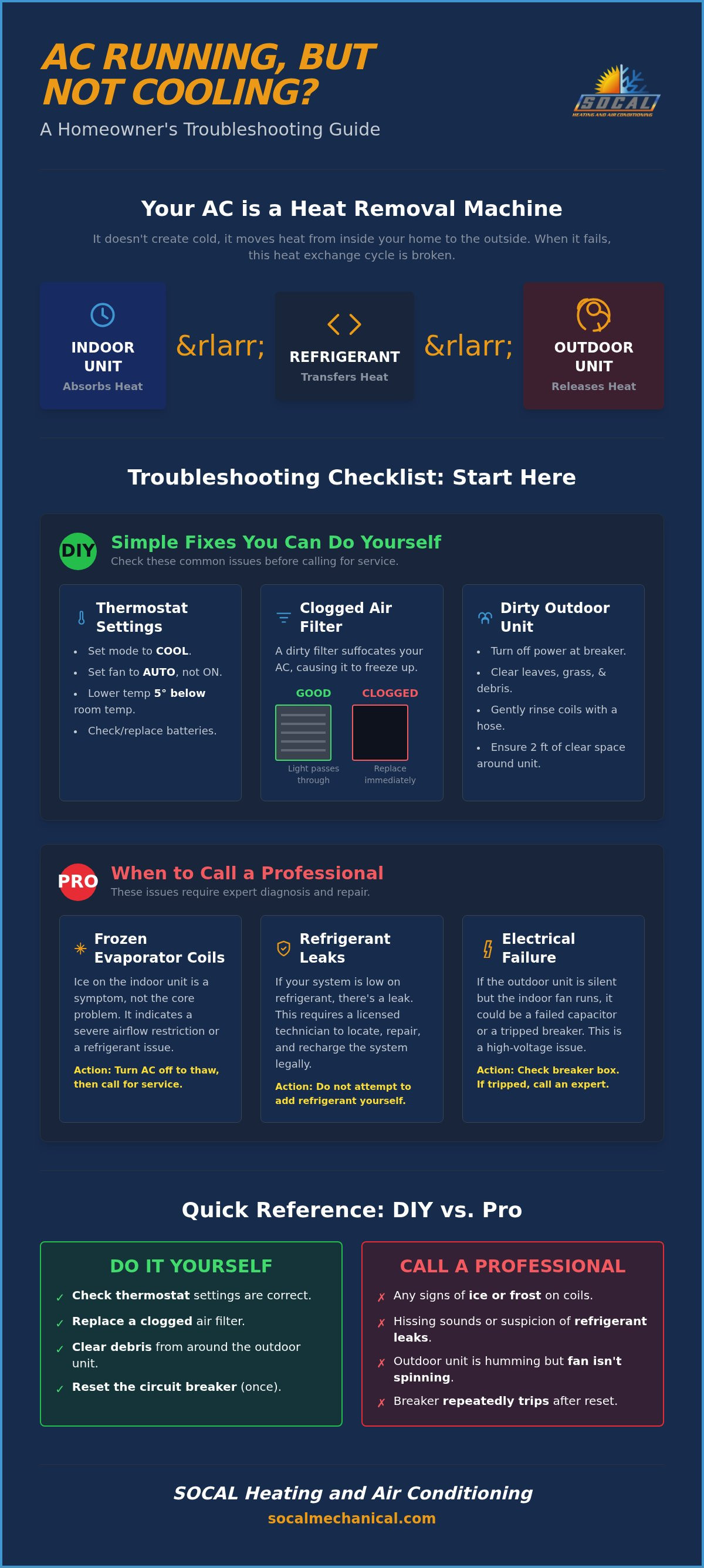
Understanding how your cooling system functions is the first step in solving the mystery of a warm house. Many people believe an air conditioner generates cold air like a fountain produces water. In reality, your system functions as a heat removal machine. When you find yourself asking why is my AC running but not cooling, you're usually witnessing a breakdown in the heat exchange cycle. The equipment is going through the motions, but the physical transfer of heat from your living space to the outdoors has stopped. This disconnect can be frustrating, especially during a humid afternoon, but it's often caused by a specific bottleneck in the system's operation.
Air conditioning works by circulating refrigerant that absorbs heat from your indoor air at the evaporator coil and releases it outside through the condenser unit. This cycle relies on three critical pillars: consistent airflow, the chemical properties of refrigerant, and a clean outdoor condenser. If any of these elements fail, the indoor blower will continue to push air through your vents, but that air won't be chilled. This is a fundamental concept in Heating, ventilation, and air conditioning (HVAC) systems. When one part of this cycle is interrupted, the rest of the system keeps running in a futile attempt to reach the temperature set on your thermostat.
Is Your Thermostat Set Correctly?
Sometimes the solution is simpler than a mechanical repair. We recommend checking your thermostat settings before worrying about a total system failure. If the fan is set to "On" rather than "Auto," the indoor blower will push air through your vents regardless of whether the cooling components are actually engaged. This results in room-temperature air circulating through your home. To ensure your system is actually trying to cool, follow these steps:
- Verify the fan is set to "Auto" so it only runs during a cooling cycle.
- Ensure the cooling setpoint is at least 5 degrees below the current room temperature.
- Check if your digital display is dim or flickering, which may indicate the batteries need replacement.
The Role of the Fan vs. The Compressor
It helps to distinguish between the two main parts of your system to understand why is my AC running but not cooling. The indoor blower fan is responsible for moving air through your ductwork and across the coils. The outdoor compressor is the "heart" of the system that actually pumps refrigerant to facilitate cooling. If you hear the indoor unit humming but the outdoor unit is silent, the compressor isn't doing its job. You'll feel air coming out of the registers, but without the compressor active, that air won't be conditioned. This scenario is common when a capacitor fails or a circuit breaker trips, leaving the fan running solo while the cooling process sits idle.
Common Culprit: Airflow Restrictions and Clogged Filters
Most homeowners are surprised to learn that the most frequent reason for a cooling failure isn't a broken motor or a complex electrical fault. It's often as simple as a layer of dust on a filter. When you're trying to figure out why is my AC running but not cooling, the first place to look is your airflow. If your system can't "breathe," it can't move heat effectively. This creates a cycle where the unit works harder and longer while the temperature in your living room continues to climb.
In Orange County, our local environment plays a significant role in how quickly these restrictions develop. The Santa Ana winds carry an incredible amount of fine dust and debris from the desert into our neighborhoods. This particulate matter settles into your HVAC system much faster than the standard "90-day" recommendation found on many filter packages. For residents in Tustin or Irvine, a filter that was clean a month ago might be completely obstructed after a single wind event. This leads to what we call the "suffocation" effect. Without enough warm indoor air passing over the cold evaporator coil, the coil temperature drops below freezing. Moisture in the air turns to ice, creating a literal wall of frost that blocks all remaining air. To properly troubleshoot your air conditioner, you must ensure the path for air is entirely clear from the intake to the vents.
How to Check and Change Your Air Filter
Most filters are located in a slot near the return air duct or within the indoor air handler. To test your filter, remove it and hold it up to a bright light source. If you can't see any light passing through the fibers, the filter is too dirty to function and should be replaced immediately. We recommend high-quality pleated filters for Tustin homes. These provide a better balance of filtration and airflow, capturing fine dust without putting undue strain on your blower motor.
Blocked or Closed Vents
It's a common myth that closing vents in unused rooms saves energy. In reality, modern systems are designed for a specific amount of air pressure. Closing too many vents increases the static pressure inside your ductwork, which can lead to frozen coils or blower failure. You should ensure at least 80% of your home's supply registers are open at all times. Also, take a moment to check that furniture, rugs, or heavy curtains haven't been moved in front of the large return air grilles. If you've cleared these physical hurdles and the house is still warm, an AC Tune Up can help identify deeper airflow bottlenecks within your ductwork.
External Issues: The Outdoor Condenser Unit
The outdoor condenser unit is the unsung hero of your cooling system. While your indoor unit is busy absorbing heat from your rooms, the outdoor unit is responsible for releasing that heat into the environment. If the condenser is dirty or neglected, the heat has nowhere to go. This often leads to the confusing scenario of why is my AC running but not cooling. The indoor blower fan will continue to push air, but since the heat isn't being exhausted outside, the air coming through your vents remains warm. This creates a cycle where the system works harder and harder without ever achieving the desired temperature.
In Orange County, our environment presents unique challenges for these units. Homeowners in cities like Laguna Niguel or Laguna Hills must contend with salt air, which can leave a corrosive film on the delicate aluminum fins. Meanwhile, those in Orange or Tustin deal with dry dirt and falling leaves that act like a blanket over the coils. It's a critical safety rule to never wrap your AC unit in plastic or use a cover while it's running. This traps heat and can cause the compressor to overheat or fail entirely. If the compressor cannot breathe, the entire heat exchange process stops immediately.
Cleaning Your Outdoor Unit Safely
Maintaining the condenser is a straightforward task that most homeowners can handle with a little patience. Before you begin, always turn off the power at the electrical disconnect box located near the outdoor unit. This ensures your safety while you work. Once the power is off, you can proceed with a basic cleaning routine:
- Rinse the fins: Use a standard garden hose to gently wash away dust and grime. Avoid using a pressure washer, as the high-force stream can easily bend and damage the thin metal fins.
- Clear the area: Trim back any bushes, vines, or tall grass to maintain a two-foot "buffer zone" around the unit. This space is necessary for proper air intake and heat dissipation.
- Remove debris: Hand-pick any leaves or twigs that have become lodged in the unit's base or against the coils.
Checking for Power Issues
Sometimes the reason why is my AC running but not cooling is purely electrical. During intense heatwaves in Anaheim or Irvine, your system works at maximum capacity for hours. This high demand can cause the outdoor unit's circuit breaker to trip. In this case, your indoor fan will still run because it's on a different circuit, but the outdoor compressor remains silent. Check your home's main electrical panel for any switches that have moved to the "off" or middle position. If a breaker trips repeatedly, it's a sign of a deeper electrical issue that requires a professional inspection to prevent permanent damage to the compressor.
Mechanical Failures: Refrigerant Leaks and Frozen Coils
A common misconception among homeowners is that refrigerant acts like gasoline in a car. Many believe it simply runs out and needs a regular refill. In reality, your air conditioner is a closed-loop system. The refrigerant is a chemical that circulates continuously to transport heat. If your levels are low, it's because there's a physical hole in the line. When you're investigating why is my AC running but not cooling, a leak is a serious mechanical failure that requires professional detection and repair. Topping off the system without fixing the leak is a temporary and expensive mistake that doesn't solve the underlying problem.
Identifying a leak often involves looking for specific physical cues. You might hear a faint hissing or bubbling sound near the indoor or outdoor units. You might also notice lukewarm air coming from the vents or see a build-up of ice on the copper lines. This ice occurs because the low pressure caused by the leak makes the refrigerant too cold, causing moisture to freeze on the coil. If you suspect this is the case, you should schedule an AC Repair immediately to prevent permanent damage to the system's heart.
If your evaporator coil has already turned into a block of ice, you must thaw it before any diagnostic work can begin. Continuing to run the unit will only thicken the ice and strain the motor. Follow these steps to safely thaw your system:
- Turn the thermostat setting to "Off" to stop the cooling cycle.
- Switch the fan setting to "On" to keep the indoor blower running.
- Wait for 2 to 4 hours to allow the ice to melt completely.
The Danger of Running a Frozen AC
Ignoring a frozen unit is a gamble that rarely pays off. When the coil is encased in ice, the refrigerant cannot absorb heat and remains in a liquid state as it returns to the outdoor unit. This leads to "liquid slugging," a condition where liquid refrigerant enters the compressor. Since liquids don't compress like gases, this can shatter the internal components of your compressor instantly. If you see ice on the exterior service valves or the indoor coil, shut the system down right away.
Failing Capacitors and Start Components
Sometimes the issue isn't the refrigerant but the electrical components that power the compressor. The capacitor is a small, cylindrical part that acts like a high-voltage battery. It provides the initial surge of energy needed to jumpstart the outdoor motors. During the intense summers in Yorba Linda and Lake Forest, extreme heat is the primary enemy of these parts. A failing capacitor might cause the outdoor unit to hum or click without the fan or compressor actually turning on. This results in the indoor fan blowing unconditioned air, which is a common reason why is my AC running but not cooling during peak demand hours.
Professional Solutions: Restoring Comfort with SOCAL
While the troubleshooting steps we've discussed can resolve many minor issues, there comes a point where professional intervention is necessary for your safety and the longevity of your equipment. If you've cleaned your filters and inspected your outdoor unit but are still wondering why is my AC running but not cooling, the problem likely lies deep within the mechanical or electrical systems. Handling refrigerant or high-voltage electrical components requires specialized tools and training. Attempting to fix a leak or replace a capacitor without the proper expertise can lead to further damage or even personal injury. We recommend stopping DIY efforts once you've addressed the basic airflow and power checks.
At SOCAL Heating and Air Conditioning, we've served as a trusted local expert in Tustin and Irvine since 2003. We believe in a "no-surprises" diagnostic approach. This means we provide a clear, straightforward explanation of what is wrong and exactly how we plan to fix it before any work begins. Our goal is to remove the uncertainty that often comes with home repairs, ensuring you feel informed and protected. If your system is aging and repairs are becoming too frequent, we can also discuss the long-term benefits of a new AC Installation Orange County homeowners can rely on for years to come. Investing in a professional tune-up now can often prevent these frustrating breakdowns before the next major heatwave arrives.
Our Thorough Diagnostic Process
We don't just look for the most obvious symptom; we look for the root cause. Our technicians perform a comprehensive evaluation of your entire cooling system to ensure we catch every potential point of failure. This methodical approach includes several critical checkpoints:
- Refrigerant Analysis: We measure levels to confirm there are no leaks in the sealed system.
- Electrical Testing: We check all connections and start components for signs of wear or heat damage.
- Airflow Integrity: We evaluate the performance of the evaporator coil and the blower motor.
- Ductwork Inspection: We check for gaps or loose connections that might be leaking chilled air into your attic.
This attention to detail ensures that once we leave your home, your indoor comfort is fully restored and stays that way. We prioritize transparency, providing you with a complete picture of your system's health.
Schedule Your AC Inspection Today
We know that waiting for a repair during a heatwave is more than just an inconvenience; it's a matter of safety. That's why we offer same-day service availability for urgent cooling needs throughout Orange County. Whether you need a simple fix or a comprehensive tune-up to prevent future breakdowns, our team is ready to help. We value our reputation over quick profits, which is why we focus on delivering high-quality craftsmanship and honest advice. We're here to restore your peace of mind and home comfort.
Get Back to Reliable Indoor Comfort
Finding an answer to why is my AC running but not cooling doesn't have to be a source of stress. Most cooling failures stem from restricted airflow or a disruption in the heat exchange cycle, often caused by something as simple as a dust-clogged filter or a dirty outdoor unit. By performing basic troubleshooting, you can rule out minor issues and gain a clearer understanding of your system's health. However, if your coils are frozen or you suspect a refrigerant leak, it's best to rely on a professional to ensure the job is done safely and correctly.
SOCAL Heating and Air Conditioning has been a locally owned and operated partner in Tustin since 2003. We take pride in our reputation for honesty and offer expert same-day AC repair to help you navigate the hottest California days without delay. Whether you need a quick fix or a thorough inspection, our team provides the "no-surprises" service you deserve. Schedule your professional AC diagnostic with SOCAL today to restore your peace of mind. We look forward to helping you stay cool and comfortable all season long.
Frequently Asked Questions
Why is my AC blowing air but not cooling the house?
This issue usually happens when the indoor fan is functioning, but the heat exchange process has been interrupted. Common causes include a thermostat set to "On" instead of "Auto," a tripped circuit breaker for the outdoor unit, or a severely clogged air filter. If you're asking why is my AC running but not cooling, it means the system is moving air through your home, but the compressor or refrigerant isn't removing the heat from that air.
How do I know if my AC evaporator coil is frozen?
You can identify a frozen evaporator coil by looking for visible ice on the copper refrigerant lines or the exterior of the indoor air handler. Other signs include a significant drop in airflow from your vents or water pooling around the base of your system as the ice begins to melt. If you notice these symptoms, turn the system off immediately to prevent damage to the compressor.
Can a dirty air filter cause my AC to stop cooling?
Yes, a dirty air filter is the most common reason for cooling failures. When dust and debris block the filter, the system cannot pull enough warm air over the evaporator coil. This causes the coil temperature to drop below freezing, leading to ice buildup that blocks all cooling. In Orange County, Santa Ana winds can cause filters to clog much faster than the typical three-month estimate.
How long should I wait for my AC to thaw if it freezes?
You should typically wait between 2 to 4 hours for the system to thaw completely. To speed up this process safely, turn the thermostat to the "Off" position and switch the indoor fan setting to "On." This circulates warm air over the ice to melt it. Do not attempt to restart the cooling cycle until all visible ice has vanished and the unit has dried.
Is it okay to run my AC if it is not blowing cold air?
No, you should shut down your system immediately if it stops blowing cold air. Continuing to run an air conditioner that isn't cooling can lead to "liquid slugging," where liquid refrigerant enters the compressor. Because the compressor is designed to handle gas, not liquid, this can cause a catastrophic mechanical failure. Turning the unit off protects your budget from expensive compressor replacement costs.
Why is my outdoor AC unit running but the indoor air is warm?
This often occurs when the outdoor condenser coils are heavily coated in dirt, leaves, or salt air film, preventing the system from releasing heat. It can also indicate a failing capacitor or low refrigerant levels. In these cases, the outdoor fan may spin, but the compressor itself isn't effectively moving refrigerant through the cycle. This is a primary reason why is my AC running but not cooling during a heatwave.
How often should I have my AC serviced in Orange County?
We recommend having your system professionally serviced at least once a year. Our local environment, with its mix of desert dust and coastal humidity, puts unique stress on HVAC components. An annual tune-up ensures that your coils are clean, electrical connections are tight, and refrigerant levels are correct, which helps prevent the most common causes of cooling failure before they start.
Will adding more refrigerant fix my AC cooling problem?
Adding refrigerant is only a permanent fix if the technician also identifies and repairs the physical leak. Refrigerant is a permanent chemical in a closed-loop system and should never "run out" like fuel. Simply topping off the system is a temporary solution that ignores the underlying mechanical failure. A professional repair should always include a leak test to ensure long-term stability and system efficiency.


